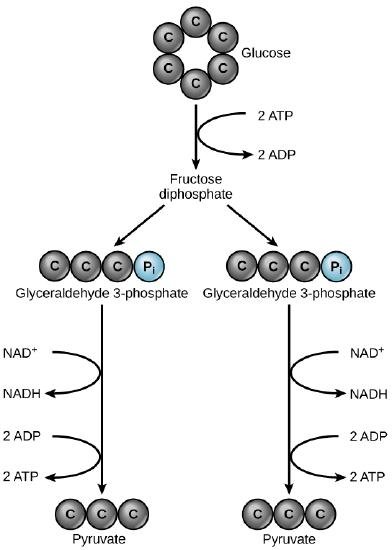
The first step in cellular respiration, which releases energy from glucose, is glycolysis. It takes place in the cytoplasm of cells and is anaerobic, meaning it doesn’t need oxygen. One glucose molecule is converted into two pyruvate molecules during glycolysis, which also yields a trace quantity of ATP (adenosine triphosphate) and NADH (nicotinamide adenine dinucleotide).
Key points about glycolysis:
- Location: Cytoplasm of the cell.
- Oxygen Requirement: Anaerobic, meaning it doesn’t require oxygen.
- Input: One glucose molecule.
- Output: Two pyruvate molecules, a small amount of ATP (net gain of 2 ATP), and 2 NADH.
- Purpose: To begin the process of breaking down glucose to release energy for the cell.
- Connection to Cellular Respiration: Glycolysis is the first step in both aerobic (with oxygen) and anaerobic (without oxygen) cellular respiration.
- Ancient Pathway: It’s an ancient metabolic pathway found in most living organisms.
- Enzymes: A series of enzymes catalyze the reactions in glycolysis, including the important enzyme aldolase that cleaves glucose.
- Energy Investment and Payoff: Glycolysis involves an energy investment phase where ATP is used, followed by an energy payoff phase where ATP and NADH are produced.
- Fermentation: In the absence of oxygen, pyruvate can be further processed through fermentation pathways, which still yield some ATP.

In essence, glycolysis is the starting point for energy extraction from glucose, regardless of whether oxygen is present or not. If oxygen is available, the pyruvate produced will move on to the next stages of aerobic cellular respiration: the Krebs cycle and oxidative phosphorylation. If oxygen is not available, the cell may undergo fermentation.
Glycolysis: What is it?
The breakdown of glucose to create energy is known as glycolysis. It generates water, ATP, NADH, and two pyruvate molecules. The procedure doesn’t need oxygen and happens in a cell’s cytoplasm. Both aerobic and anaerobic creatures experience it.
Glycolysis is the primary step of cellular respiration, which occurs in all organisms. Glycolysis is followed by the Krebs cycle during aerobic respiration. In the absence of oxygen, the cells make small amounts of ATP as glycolysis is followed by fermentation.

This metabolic pathway was discovered by three German biochemists- Gustav Embden, Otto Meyerhof, and Jakub Karol Parnas in the early 19th century and is known as the EMP pathway (Embden–Meyerhof–Parnas).
Glycolysis Pathway
The glycolysis pathway occurs in the following stages:
Stage 1
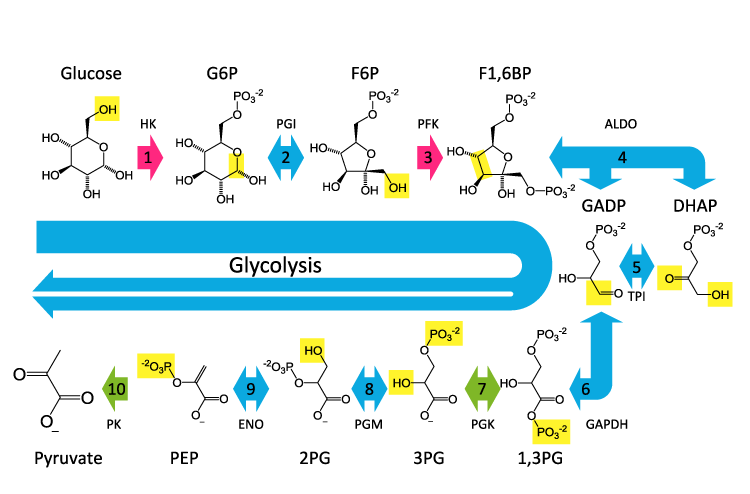
- A phosphate group is added to glucose in the cell cytoplasm by the action of the enzyme hexokinase.
- In this, a phosphate group is transferred from ATP to glucose forming glucose,6-phosphate.
Stage 2
Glucose-6-phosphate is isomerised into fructose-6-phosphate by the enzyme phosphoglucomutase.
Stage 3
The other ATP molecule transfers a phosphate group to fructose 6-phosphate and converts it into fructose 1,6-bisphosphate by the action of the enzyme phosphofructokinase.
Stage 4
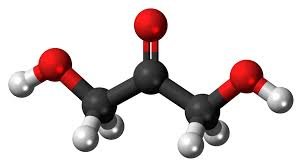
The enzyme aldolase converts fructose 1,6-bisphosphate into glyceraldehyde 3-phosphate and dihydroxyacetone phosphate, which are isomers of each other.
Step 5
Triose-phosphate isomerase converts dihydroxyacetone phosphate into glyceraldehyde 3-phosphate, which is the substrate in the successive step of glycolysis.
Step 6
This step undergoes two reactions:
- The enzyme glyceraldehyde 3-phosphate dehydrogenase transfers 1 hydrogen molecule from glyceraldehyde phosphate to nicotinamide adenine dinucleotide to form NADH + H+.
- Glyceraldehyde 3-phosphate dehydrogenase adds a phosphate to the oxidised glyceraldehyde phosphate to form 1,3-bisphosphoglycerate.
Step 7
Phosphate is transferred from 1,3-bisphosphoglycerate to ADP to form ATP with the help of phosphoglycerokinase. Thus, two molecules of phosphoglycerate and ATP are obtained at the end of this reaction.
Step 8
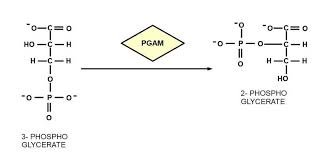
The phosphate of both phosphoglycerate molecules is relocated from the third to the second carbon to yield two molecules of 2-phosphoglycerate by the enzyme phosphoglyceromutase.
Step 9
The enzyme enolase removes a water molecule from 2-phosphoglycerate to form phosphoenolpyruvate.
Step 10
A phosphate from phosphoenolpyruvate is transferred to ADP to form pyruvate and ATP by the action of pyruvate kinase. Two molecules of pyruvate and ATP are obtained as the end products.
Key Points of Glycolysis
- It is the process in which a glucose molecule is broken down into two molecules of pyruvate.
- The process takes place in the cytoplasm of plant and animal cells.
- Six enzymes are involved in the process.
- The end products of the reaction include 2 pyruvate, 2 ATP, and 2 NADH molecules.
ATP is produced in this process, which takes place in the cytosol of the cytoplasm.

Splitting Glucose
The word means “glucose splitting,” which is exactly what happens in this stage. Enzymes split a molecule of glucose into two molecules of pyruvate (also known as pyruvic acid). This occurs in several steps. Glucose is first split into glyceraldehyde 3-phosphate (a molecule containing 3 carbons and a phosphate group). This process uses 2 ATP. Next, each glyceraldehyde 3-phosphate is converted into pyruvate (a 3-carbon molecule). This produces two 4 ATP and 2 NADH.